What is a sewer lateral and who is responsible for repairing it?
A sewer lateral is the pipe that carries waste from your house to the main sewer line. You usually hear the term when a camera shows a crack, or when every drain in the house backs up at once.
It starts where your drain lines leave the building and runs underground to the connection with the main. Older laterals are often clay, cast iron or fibre pipe, and they fail in familiar ways. Roots work into a clay joint. The pipe sags into a belly that holds water. A section cracks or collapses. Scale narrows cast iron until little gets through.
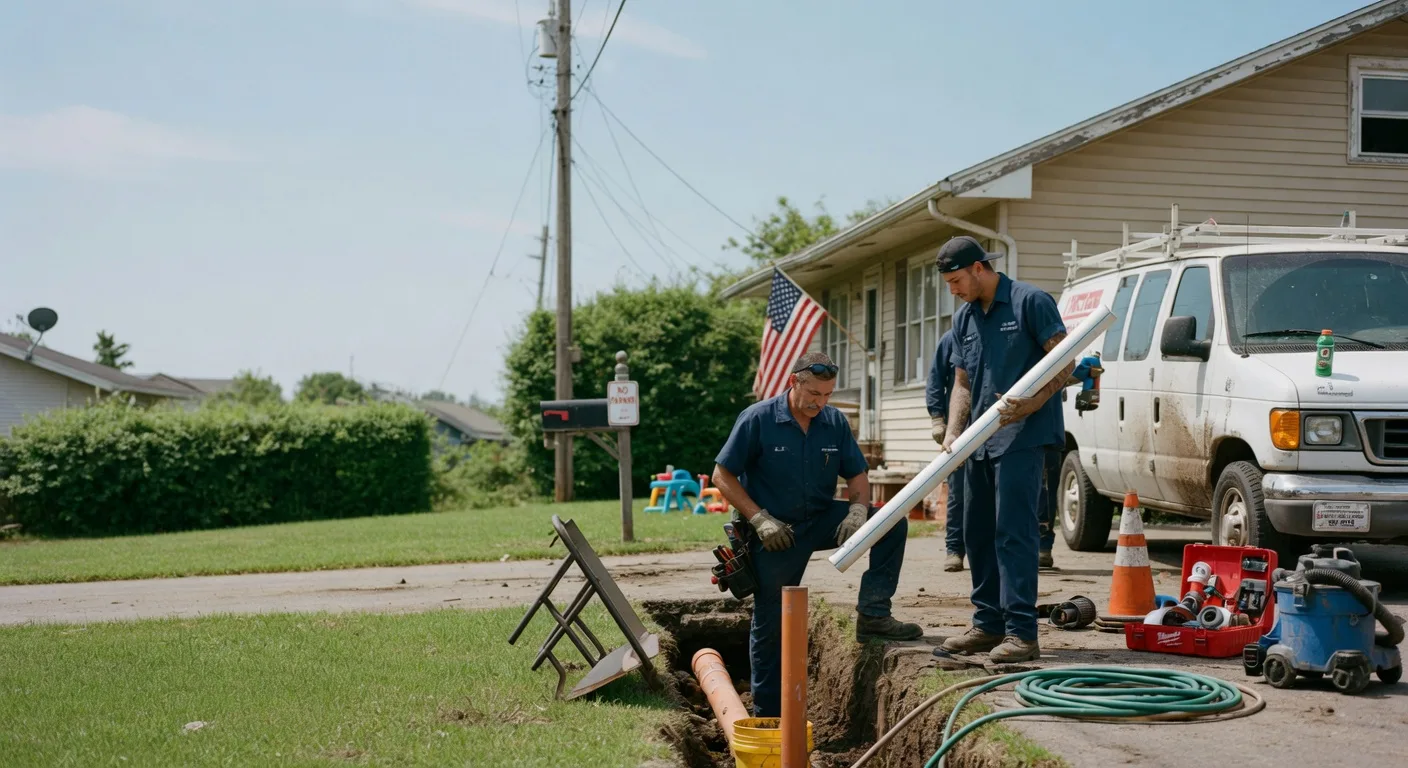
Who repairs it depends on where the fault is and on local rules. In many places the owner is responsible for the lateral up to the property line, and sometimes all the way to the main. In others the utility owns the part under the street. Your city or sewer utility can tell you where responsibility sits for your address in Ridgeland, SC. Ask before you assume.
Safe homeowner check: note which drains are slow, and whether it is one fixture or all of them. Stop running water and call now if every drain is backing up, or if sewage is coming up in a tub or floor drain.
A camera inspection finds the break. Cost depends on depth, access, how much must be dug or opened, the materials, and any permit. Expert Plumbers Co is a referral service. Call (380) 262-9173 and we will connect you with a plumber in Ridgeland, SC.
Ask the plumber whether the camera run can note the distance from the cleanout to the fault, so you can tell which part of the lateral is the problem. A fault near the house, a fault at the property line and a fault under the street can each land with a different owner. Before any repair, take a screenshot or copy of the footage and keep a note of the date. Local rules may require a permit, an inspection by the building department or the utility, or notice to the sewer authority, so check before digging starts. Some utilities or cities also run programs that cover part of a lateral repair, and a few require an inspection when a property is sold. Ask your homeowner policy provider what it says about sewer line damage, because many standard policies leave it out. Older neighborhoods with mature trees tend to have more root problems, so it is worth asking about a root-resistant joint when the pipe is renewed.
My dishwasher leaves standing water at the bottom and the kitchen sink is slow too. Are they connected?
Yes, most of the time. The dishwasher drains into the same pipe as the kitchen sink, usually through the disposal or a connection on the tailpiece. If that shared pipe is partly blocked, both will slow down, and the dishwasher shows it first because it cannot push water out against the restriction.
Grease, food residue and soap film coat the inside of the kitchen drain and narrow it over time. A garbage disposal can pack ground food into that narrow spot. The result is water that sits in the bottom of the dishwasher after a cycle and a sink that empties slowly.
Safe checks you can do: look at the dishwasher filter at the bottom and clear any food. Check that the drain hose is not kinked behind the machine. If you have a disposal, make sure the knockout plug was removed when the dishwasher was installed. Run the disposal with cold water and see whether the sink drains better. Take off the trap under the sink with a bucket below, and clear what is in it. Skip chemical cleaners, which can damage the dishwasher hose and the disposal.
If the filter and trap are clean and both problems remain, the blockage is further down the kitchen line. A cable machine often clears a soft plug of grease and food. If it returns in a few weeks, grease on the pipe wall is the likely cause, and hydro jetting cleans the wall where a cable only cuts a hole through it. A camera inspection can show a sag, a damaged joint or roots further along.
Stop running the dishwasher and call if dirty water comes up in the sink during a cycle, if other drains in the house are also slow, or if you smell sewage.
If the sink drains fine once the dishwasher is off and the problem is only the machine, the cause may be in the appliance, such as the pump or drain hose, and that is a job for an appliance technician rather than a plumber.
Cost depends on access under the sink, how far the blockage sits, whether a cleanout is available, and how much has to be opened or replaced.
Expert Plumbers Co can connect you with an independent local plumber in Ridgeland, SC when you call (380) 262-9173.
Can a drain cable or hydro jetting damage old pipes like cast iron, clay or thin-wall pipe?
Yes, it can, and a good plumber knows that before the machine is switched on. Old pipe is not equally fragile everywhere, and the choice of tool depends on what the pipe is made of and what shape it is in.
Cable machines spin a cutting head against the pipe wall. In sound pipe that is fine. In clay with offset joints, the head can catch on a lip and snag. In cast iron with heavy scale, a cutting head can knock loose flakes, and in a pipe already thinned by corrosion it can punch through. Thin-wall plastic or older Orangeburg-type fiber pipe can be gouged or deformed.
Hydro jetting pushes water at high pressure through a nozzle. On solid pipe it cleans the walls better than a cable. On a cracked clay pipe, a corroded cast iron stack, or a joint that has already shifted, that pressure can widen the damage or send water out into the soil.
So how does the plumber decide? Usually from several clues:
The age and material of the house and the pipe, which tells the plumber what to expect.
Past history, such as repeated roots, earlier repairs, or a line that has never been inspected.
How the cable behaves. A head that bounces, stops at the same distance, or comes back with pipe chips or rust flakes suggests the pipe itself is damaged.
A camera look first. This is the most direct answer. If the line is fragile or offset, the plumber can choose a gentler head, lower pressure, or no jetting at all.
If you suspect old pipe, say so on the phone. Tell the plumber the age of the house and the pipe material if you know it. Ask whether the tool will be matched to the pipe, and whether a camera look comes first.
Sometimes the honest answer is that a quick clearing is worth the risk to get water moving, with a plan to inspect afterward. Sometimes it is not. Either way, the decision should be explained to you before the work starts, not after.
If you need a drain cleared in Ridgeland, SC, Expert Plumbers Co can connect you with an independent local plumber at (380) 262-9173.
The house has old galvanized steel drain lines. Why do they keep clogging, and what can cleaning fix?
Galvanized steel was used for drains in older houses, and it ages badly. The zinc coating wears off, the steel underneath rusts, and the inside wall turns rough and flaky. Rust scale builds up in layers, so the pipe gets narrower every year. Hair, soap and grease catch on that rough surface much more easily than on smooth plastic.
That is why you may see slow drains that clear for a few weeks and then slow down again. Threaded joints and fittings also form ledges where debris collects, and horizontal runs with little fall hold water and silt.
What cleaning can do: a cable machine can open a clog and scrape some loose scale off the wall. Hydro jetting can strip more of the buildup and restore much of the bore, as long as the pipe is still sound. A camera look first shows how thick the scale is and whether the steel is thinning.
What cleaning cannot do: it cannot make a worn pipe new. Rust scale can be holding a weak spot together, and aggressive cleaning of a pipe that is corroded through can open a leak or let a section collapse. A pipe that has pinholes, rusted fittings or wet stains at the joints is near the end of its life, and clearing it again and again is a short-term answer.
Do not use chemical drain cleaners on old steel. They sit in low spots and speed up the damage, and they are a hazard for whoever opens the line afterward.
A safe check: look in the basement or crawlspace for rust streaks, flaking, drips or damp spots on the drain pipes. If you see them, or if every fixture on the same stack runs slowly, tell the plumber what you found.
If a section is too far gone, the usual choices are to replace the worn runs with modern pipe or, for some lines, to line them. Cost depends on how much pipe is involved, how easy it is to reach, whether walls or floors must be opened, the materials, and local permit rules.
Expert Plumbers Co can connect you with an independent plumber in Ridgeland, SC for this: call (380) 262-9173.
My child flushed a toy, or something solid went down the toilet. What should I do, and what should I not do?
Stop first. Do not flush again, even if the water looks like it is going down. Each flush pushes the object further along, and it can lodge in the toilet's trap or in the drain behind it. Tell everyone in the house not to use that toilet.
If the toilet still drains but the bowl is high, leave it. If it is rising toward the rim, lift the tank lid and push the flapper down, or turn the shutoff valve behind the toilet clockwise to stop more water entering.
What is safe to try: if you can see the object near the bowl opening and it is not breakable, put on gloves and pick it up. Use a wet vac or a closet auger only if you are comfortable with it, because an auger can also shove a hard toy deeper. Be gentle with a plunger. A plunger can free a soft item, such as paper or cloth, but it often wedges a solid piece tighter.
What not to do: do not use chemical drain cleaners, which do nothing to a solid object and make the water dangerous to handle. Do not keep plunging hard, and do not push a coat hanger down the drain, which can scratch the porcelain or drive the object into the pipe wall.
If the object has already gone and the toilet seems normal, watch for slow drains, gurgling or other fixtures backing up over the next few days. A small toy can catch in a bend and collect paper behind it. If the toilet becomes slow, or the same one keeps clogging, the object is probably still in the line.
In that case the plumber may pull the toilet off its seat to retrieve it from underneath, which is often cleaner than cabling into a pipe. If the item is in the drain behind the toilet, a camera can find it and the plumber can retrieve it or push it clear. Cost depends on where it lodged, whether the toilet must be removed, and how much access is needed.
Expert Plumbers Co can connect you with an independent plumber in Ridgeland, SC for this: call (380) 262-9173.